
By Dan, Peachy Beach · Last checked: October 2026
Yes, Aruba does get sargassum, but a lot less than most of the Caribbean, and mostly on beaches you wouldn’t swim at anyway. My honest take on Aruba sargassum after 20+ years on the island’s south coast: Aruba is pretty good, but not perfect. The brown seaweed that buries beaches in Cancún, Punta Cana and Barbados in a bad summer rarely reaches Aruba’s hotel beaches. At our own beach in Savaneta, it shows up rarely, and when it does, it’s light.
The “not perfect” part is the island’s wild windward coast. That rugged north and east shore faces the trade winds, and that’s where Aruba’s sargassum lands in the years it shows up. Here’s where it goes, when it comes, what 2026 has looked like, and how to check before you fly.
The short answer: sargassum in Aruba
- Does Aruba get it? Some years, yes. Aruba’s environment department puts it at about one serious wash-up a year, almost always on the windward north and east coast.
- The hotel beaches: Eagle Beach and Palm Beach are on the sheltered west coast. We couldn’t find a single news report of sargassum there.
- Savaneta and the south coast: rare and light, in our 20+ years at Peachy Beach.
- When: most of Aruba’s recorded episodes arrived between late February and May. Across the Caribbean, the season usually peaks in June and July.
- 2026 so far: a huge year for the Caribbean as a whole, but we found no reports of sargassum washing up in Aruba.
- Why Aruba gets so little: it sits in the far southern Caribbean, just off Venezuela, and the wind blows from the east almost all year, so the south and west coasts are sheltered.
Does Aruba Have Sargassum?
Aruba has sargassum some years, but far less than the islands to its north and east. Aruba sargassum mostly washes up on the uninhabited windward coast, and it rarely makes it to the beaches where visitors swim.
The most useful local source is a 2022 University of Aruba research paper on sargassum (in English), which interviewed the people in charge. The director of Aruba’s environment department (DNM) said the island gets a serious influx about once a year on average, on the windward shores. He called it “a concern but not a threat.” The paper also notes that tourism on Aruba sits on the leeward side, where influxes are even less frequent.
You’ll sometimes read that sargassum “doesn’t exist” in Aruba. That’s too strong. Here are the episodes we could find in the local news and that paper:
- Around 2014: when the seaweed returned three years after the first big Caribbean wave, both Aruba and Bonaire ran large cleanups.
- March 2018: a small amount at the tip of Boca Grandi, on the southeast coast, while neighboring Bonaire had its worst influx on record.
- March 2019: a thick, smelly layer on north-coast beaches, including Dos Playa.
- May 2019: public works crews cleared sargassum north of Arashi, at the island’s northwest tip. It’s the only report we found anywhere near the west-coast beaches.
- Late February to March 2022: the best-documented recent episode, with brown mats in the southeast near San Nicolas and Baby Beach (Aruba Today, March 2022).
- 2025: large fields were spotted offshore in May, and in July a politician said you could see sargassum along the north coast. That was the Caribbean’s record year, and we found no reports of it reaching Aruba’s tourist beaches.
That’s the real picture: Aruba gets a dusting in some years, and an occasional bad week on the wild side of the island. It doesn’t get the summer-long brown carpets of the Mexican Caribbean.
Why Aruba Gets So Little Sargassum
Aruba is spared mainly by geography and wind. It sits at the far southern edge of the Caribbean, about 18 miles (29 km) off Venezuela, and the wind blows from the east almost every day of the year.
Sargassum floats, so it goes wherever the currents and the wind push it. Aruba’s meteorological department recorded wind from the east 91.5% of the time in 2020, and from the east-southeast the rest of the time. NOAA researchers found that adding onshore wind to their satellite maps greatly improved predictions of where sargassum washes up. On Aruba, an east wind blows straight onto the north and east coast. On the south and west coasts, where the hotels, Savaneta and most of the swimming beaches are, it blows along the shore or out to sea.
Aruba is also last in line among its neighbors. According to that University of Aruba paper, when a mat of sargassum drifts toward the ABC islands, it usually reaches Bonaire first, Curaçao about two days later and Aruba about four days later. A lot of it never makes it that far. In March 2018, Bonaire had its worst influx on record, and nothing unusual reached Aruba.
Where Sargassum Lands in Aruba: Coast by Coast
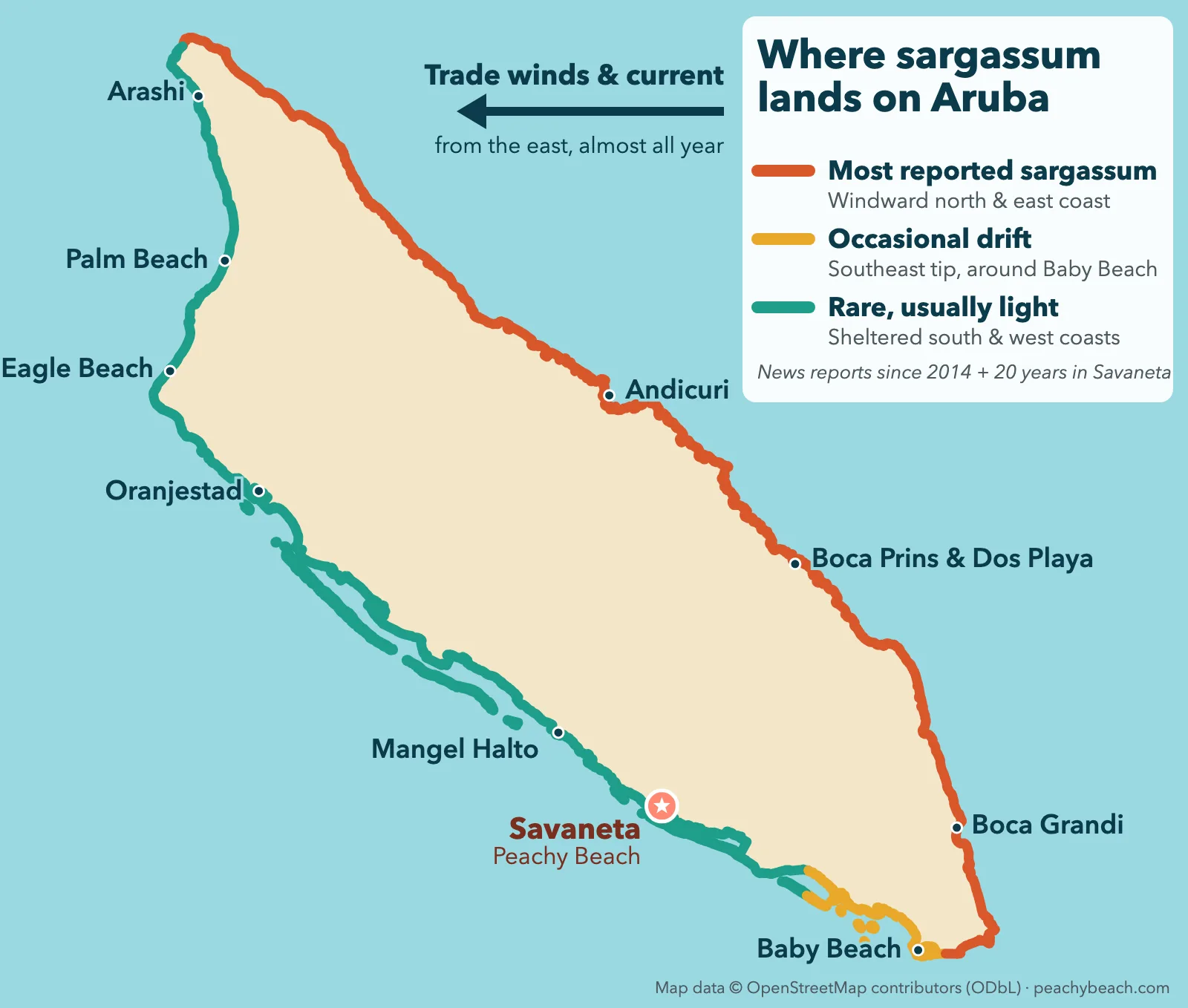
Aruba sargassum lands mostly on the windward north and east coast, occasionally drifts around the southeast tip near Baby Beach, and rarely reaches the sheltered south and west coasts. Here’s the map we made from those reports and our own years on the island.
| Coast | Beaches | Sargassum risk | What we know |
|---|---|---|---|
| Windward north & east | Boca Prins, Dos Playa, Andicuri, Boca Grandi, the Natural Bridge area | Highest | Where most of Aruba’s reported sargassum lands. The park usually lets the sea take it back out. |
| Southeast tip | Baby Beach, Rodgers Beach, San Nicolas | Occasional | The 2022 episode brought mats near Baby Beach. |
| South coast | Savaneta, Mangel Halto, Pos Chiquito | Rare, light | No news reports found. In our 20+ years at Peachy Beach, it’s been rare and light. |
| West coast | Eagle Beach, Palm Beach, Arashi, Druif, Manchebo | Rare | No reports found at Eagle or Palm. One 2019 cleanup north of Arashi. Hotels rake their own beaches. |
Several windward beaches, like Boca Prins and Dos Playa, are inside Arikok National Park. They’re spectacular, but like the rest of that coast, they’re rough-water beaches where swimming isn’t safe even on a perfect day. Our guide to Arikok National Park and off-roading in Aruba covers them. So even in a bad week, the sargassum is usually piling up where you’d go for photos, not for a swim.
Sargassum in Savaneta: What We’ve Seen at Peachy Beach
On our stretch of Savaneta, sargassum is rare and light. We’ve been on this beach for more than 20 years, and it does turn up every so often, but very rarely. It has never been anything like the brown carpets you see in photos from Mexico or the Dominican Republic.
That fits the geography. Savaneta is on Aruba’s south coast, facing the calm Caribbean side, and the east wind runs along the shore rather than onto it. The water out front is calm and clear, with a reef just offshore that’s great for snorkeling and kayaking. (New to the area? Start with our complete guide to Savaneta, Aruba.)

When Is Aruba Sargassum Season?
Aruba doesn’t have a reliable sargassum season, but most of its recorded episodes arrived between late February and May. Across the wider Caribbean, sargassum builds in spring, peaks around June and July, and fades by late fall.
That’s a little earlier than the Caribbean-wide peak. The March 2018, March and May 2019, and February–March 2022 episodes all came in the first half of the year. So did most of Bonaire’s big influxes, which usually hit its east coast in late winter or spring.
Winter is usually the clearest time across the region. The University of South Florida, which tracks sargassum by satellite, reported Caribbean amounts falling to their lowest levels around October and November in 2025. Even winter isn’t guaranteed, though: parts of Mexico and the Lesser Antilles got unusual sargassum in December 2025 and January 2026.
For Aruba specifically, I wouldn’t plan a trip around sargassum at all. In any month, the odds that it affects your beach day on the south or west coast are low.
Aruba Sargassum in 2026 (and the Record 2025 Season)
2026 has been the second-biggest sargassum year ever recorded in the Caribbean and Atlantic, after 2025. Even so, as of late October 2026, we haven’t found a single report of sargassum washing up in Aruba this year.
The numbers come from the University of South Florida’s Sargassum Watch System, which publishes a monthly outlook:
- 2025, the record year: about 38 million metric tons across the Atlantic, Caribbean and Gulf in July 2025, the most ever measured.
- 2026: an unusually early start (a record December 2025), then a peak of about 33.6 million tons in June 2026. USF calls 2026 the second-largest year on record.
- Since the peak: amounts dropped to about 12.5 million tons in August and 6 million in September. USF expected them to keep falling until about November.
Mexico, Barbados, Florida and the Lesser Antilles took the brunt of it. Closer to home, Bonaire’s east coast and Curaçao’s north-coast bays both had influxes in spring 2026. A member of Aruba’s parliament has asked the government about preparedness, and a University of Aruba student has studied sargassum at north- and south-coast beaches, but no wash-ups have made the local news.
How to Check Aruba Sargassum Conditions Before Your Trip
No tool gives a reliable beach-by-beach sargassum forecast for Aruba. Use the regional outlooks to judge the year, then ask someone on the island about the beach you care about.
- USF monthly outlook. The Sargassum Watch System page links to a short PDF bulletin at the end of every month. It tells you whether it’s a heavy year and which regions are hit. USF itself says the bulletins can’t predict a specific beach.
- NOAA’s sargassum page. NOAA Ocean Service collects the US government’s maps and explainers. Its daily beaching-risk map focuses on the islands further north and east and may not cover Aruba at all.
- Bonaire news as an early signal. Bonaire gets hit first. If its east coast is in the news, Aruba’s windward coast may see some a few days later. Often it doesn’t, so treat it as a heads-up, not a forecast.
- Ask your host. If you’re staying with us, just message us and we’ll tell you what the water looks like that morning. Any local host can do the same.
Is Sargassum Dangerous?
Fresh sargassum floating in the water isn’t toxic. The problem is seaweed that piles up on the beach and rots. After a couple of days it releases hydrogen sulfide, which smells like rotten eggs and can irritate your nose, throat and lungs.
Health agencies agree on the basics. Here’s what the Florida Department of Health, the US EPA and French health authorities in Martinique and Guadeloupe recommend:
- Most people are fine on an open, breezy beach. Florida’s health department says the general public shouldn’t have any health problems there.
- People with asthma or other breathing problems, babies, pregnant women and older people should keep away from rotting piles, especially downwind. Leave if you feel symptoms. At high levels the gas deadens your sense of smell, so don’t rely on your nose.
- Don’t swim through thick mats. Tiny creatures that live in sargassum can cause itchy skin, and it’s unpleasant to swim through anyway. Clear water next to a few loose strands is fine.
- Don’t dig in the piles or eat it. Sargassum can contain arsenic and other heavy metals. Keep kids and dogs out of the heaps.
- Itchy “sea lice” are a different thing. Seabather’s eruption comes from tiny jellyfish larvae, not from sargassum.
In Aruba, piles big enough to smell are rare, and they’re almost always on the windward coast, far from the hotels and from Savaneta.
What to Do If Seaweed Shows Up at Your Beach
On an island this small, you can drive around sargassum. Aruba is about 20 miles long, so a sheltered beach is never far away.
- Go leeward. If the windward or southeast coast is weedy, the west-coast beaches (Eagle, Palm, Arashi) and the south coast are your best bet. From Savaneta, Mangel Halto is a few minutes’ drive, and the hotel beaches are about 25 to 35 minutes away.
- Get on or under the water. Calm, reef-protected water like ours in Savaneta is great for snorkeling, paddleboarding and kayaking, and it’s the side of the island sargassum rarely reaches.
- Take a beach break. Spend the day exploring Arikok National Park, or work through our list of the best things to do in Aruba.
- Eat. Nothing fixes a beach plan like fried fish on the dock. Here’s our local’s guide to Savaneta Aruba restaurants.
Aruba vs Other Caribbean Islands for Sargassum
If avoiding sargassum is high on your list, Aruba is one of the safest bets in the Caribbean. The southern Caribbean islands get far less of it than Mexico, the Dominican Republic and the Eastern Caribbean. Among the ABC islands, Aruba gets the least. According to the head of CARMABI, Curaçao’s marine research institute, Bonaire is hit hardest and Aruba least.
| Destination | How much sargassum | Where it lands |
|---|---|---|
| Aruba | Low | The windward north and east coast. The hotel beaches and Savaneta rarely get it. |
| Curaçao | Low to moderate | North-coast bays like Boka Ascension and Sint Joris. Heavy in spring 2026. |
| Bonaire | Moderate to high on the east coast | Lac Bay and the east coast, most years since 2015 |
| Turks & Caicos | Moderate to high | East-facing coasts. Grace Bay usually stays clear. |
| Barbados | High | East and south coasts. About 3.6 million pounds removed in 2026 by mid-September. |
| Mexican Caribbean (Cancún, Playa del Carmen, Tulum) | High most summers | In early October 2026, 21 of 140 monitored beaches were still rated “excessive”. |
| Punta Cana, Puerto Rico, USVI | High in heavy years | All among the hardest-hit places in 2025. |
What Is Sargassum, Anyway?
Sargassum is a brown seaweed that floats on the open ocean its whole life, held up by little gas-filled bladders. Out at sea it’s a good thing: according to NOAA, it shelters baby sea turtles, fish, crabs and shrimp, and it’s a nursery for mahi-mahi.
The problem started in 2011. Since then, a huge new band of sargassum, the “Great Atlantic Sargassum Belt”, has formed across the tropical Atlantic, from West Africa to the Caribbean. In 2018 it was already the biggest seaweed bloom ever recorded, more than 5,000 miles long. It has kept breaking records since. Scientists are still debating what feeds it; ocean nutrients, river runoff and changing winds are all in the mix. Whatever the cause, it’s now a fact of life for much of the Caribbean every summer. Aruba is lucky to sit at the far southern edge of it.
Aruba Sargassum FAQ
Does Aruba have sargassum?
Sometimes, but much less than most Caribbean islands. Aruba’s sargassum mostly washes up on the rugged windward north and east coast, roughly once a year on average. The swimming beaches on the west and south coasts, including Eagle Beach, Palm Beach and Savaneta, rarely get any.
When is sargassum season in Aruba?
Aruba has no dependable season. Most of its recorded episodes came between late February and May. Across the Caribbean, sargassum usually peaks in June and July and is lowest in the fall and early winter.
Does Eagle Beach get sargassum?
Very rarely. Eagle Beach is on Aruba’s sheltered west coast, and we couldn’t find any news report of sargassum washing up there. Palm Beach is the same. The hotels also rake the sand in front of their properties.
Which beaches in Aruba get sargassum?
Mostly the windward beaches: Boca Prins, Dos Playa, Andicuri, Boca Grandi and the Natural Bridge area. The southeast tip around Baby Beach occasionally gets some, as it did in early 2022. Swimming isn’t recommended at most windward beaches anyway because of the strong currents.
Is there sargassum in Aruba right now?
As of our last check in October 2026, we hadn’t found any reports of sargassum on Aruba’s beaches this year. Conditions can change within days, so check the latest USF sargassum outlook and ask your host or hotel a few days before you travel.
Is it safe to swim with sargassum in the water?
Swimming in clear water with a few strands floating around is fine. Avoid swimming through thick mats, which can carry tiny creatures that make your skin itch. If you have asthma, stay away from piles rotting on the sand, because they give off hydrogen sulfide.
Which Caribbean islands don’t get sargassum?
No Caribbean island is completely sargassum-free, but the southern Caribbean islands get the least. Of the ABC islands, Aruba gets the least, followed by Curaçao and then Bonaire. On any island, the west- and south-facing coasts sheltered from the trade winds usually stay clearest.
Our Take: Pretty Good, Not Perfect
If you’re choosing between Caribbean islands and sargassum worries you, Aruba is a smart pick. It’s not because Aruba has zero sargassum. It’s because the little it gets lands on the side of the island you visit for the views, not the swimming. We’ve watched the water off Savaneta for more than 20 years, and seaweed has almost never been what decided our beach day.
If you’d like to see it for yourself, our villas sit right on that calm south-coast water. Read about staying in a Savaneta beachfront rental at Peachy Beach, or look at the Beachfront Two-Bedroom Villa, with beach toys for the kids, and the Beachfront Romantic One-Bedroom Villa, a few steps from the water.
Want to wake up on Aruba’s calm side? See our beachfront villas and check availability.
About the author: Dan has spent more than 20 years in Savaneta and runs Peachy Beach, a handful of beachfront villas on the Savaneta waterfront. What we say about our own beach comes from two decades of looking at it every morning. The rest is checked against local news, Aruba’s environment department and the University of South Florida’s satellite data. We do rent villas on the south coast, so we’ve tried to be extra careful to give you the full picture, windward coast included.
Seen sargassum in Aruba lately? Tell us and we’ll update this page.
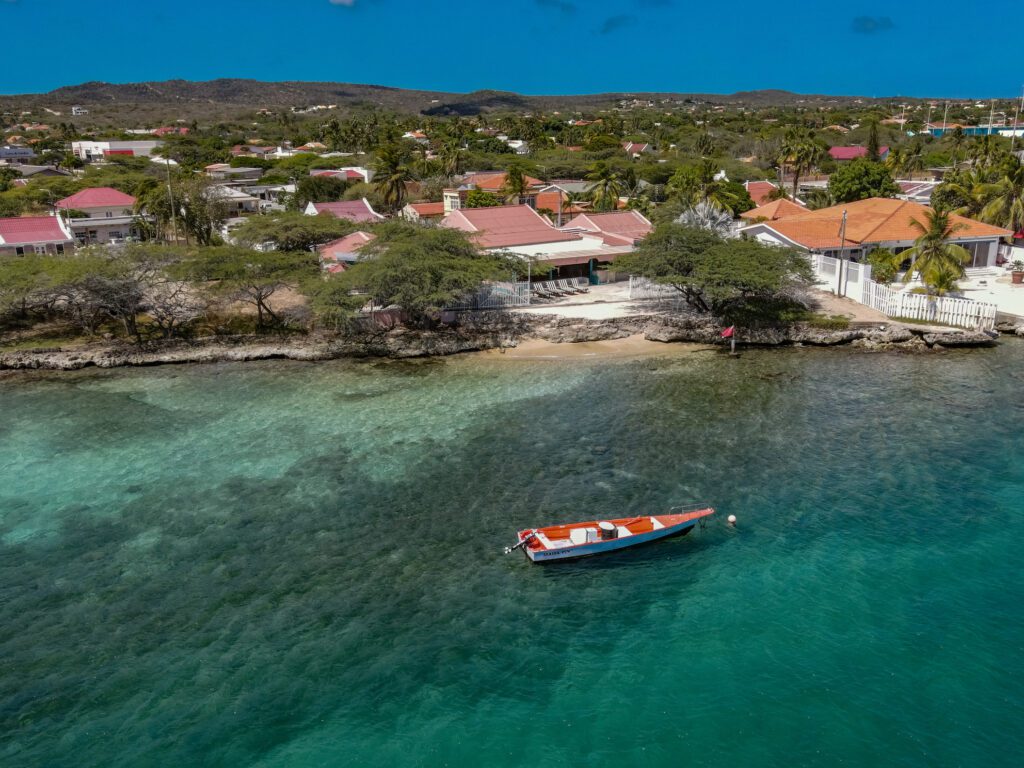
Top photo: the Savaneta coast by Peachy Beach.