
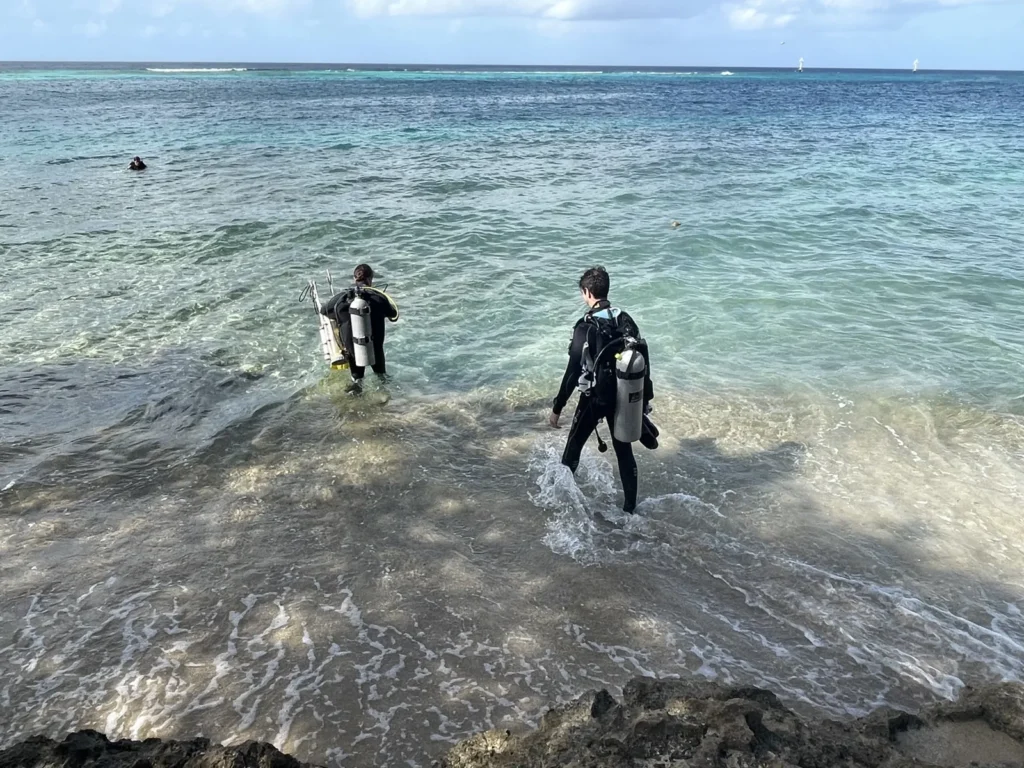
By Dan, Peachy Beach · Last checked: October 2026
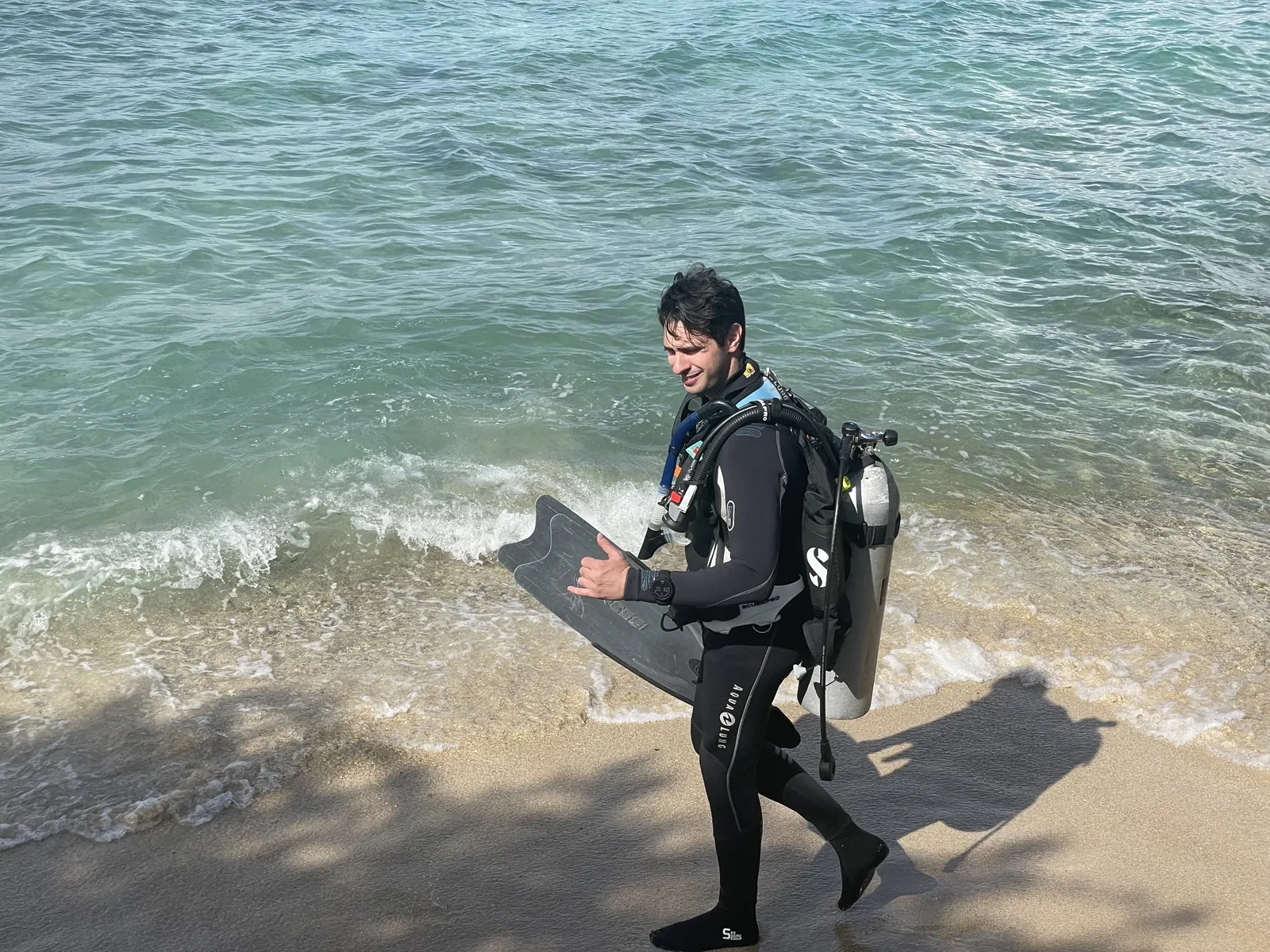
One of my favorite things in the world is kitting up in the living room, walking out the door and stepping into the Caribbean. At Peachy Beach in Savaneta, the house reef is right across the bay. There’s no boat schedule, no dive-shop van and no meeting time. You dive when the water looks right and come back when you’re hungry. That’s what Aruba shore diving is like on the island’s calm south coast, and after more than 20 years as part of the Savaneta community, it’s still the thing I’m most excited to share with guests.
Most diving in Aruba happens from boats on the west coast. The south coast is different. The reef runs close to shore from Spaans Lagoen to Savaneta, and three of the island’s best shore dives are a few minutes’ drive from our door: Hole in the Wall, Mangel Halto and Santo Largo. Here’s how to dive and snorkel them, how to get across the reef, which local shops to call, and the rules that keep it all healthy.
The short answer: Aruba shore diving on the south coast
- Is Aruba good for shore diving? Yes, especially on the south coast, where the reef sits close to land and the trade winds blow along the shore instead of onto it.
- Best shore dives near Savaneta: Hole in the Wall (Bou Baranca) in Pos Chiquito, Mangel Halto (the outer reef and the little Kappel tug wreck) and Santo Largo Reef.
- Best for snorkelers: Mangel Halto on a calm day. Isla di Oro by boat.
- Our house reef: right across the bay from Peachy Beach. Divers and strong swimmers walk in from the beach and swim out. Ask us about the crossing points first.
- Dive shops: Aruba Bob Snorkel & Scuba and Nautilus Dive Center are both in Savaneta. JADS, by Baby Beach, rents tanks to certified divers.
- Rules: no marine park fee. Leave the speargun at home, don’t touch or take anything, and don’t bring sunscreen with oxybenzone; it’s banned.
- Water: about 79–85 °F (26–29 °C) all year.
South Coast Dive and Snorkel Sites at a Glance
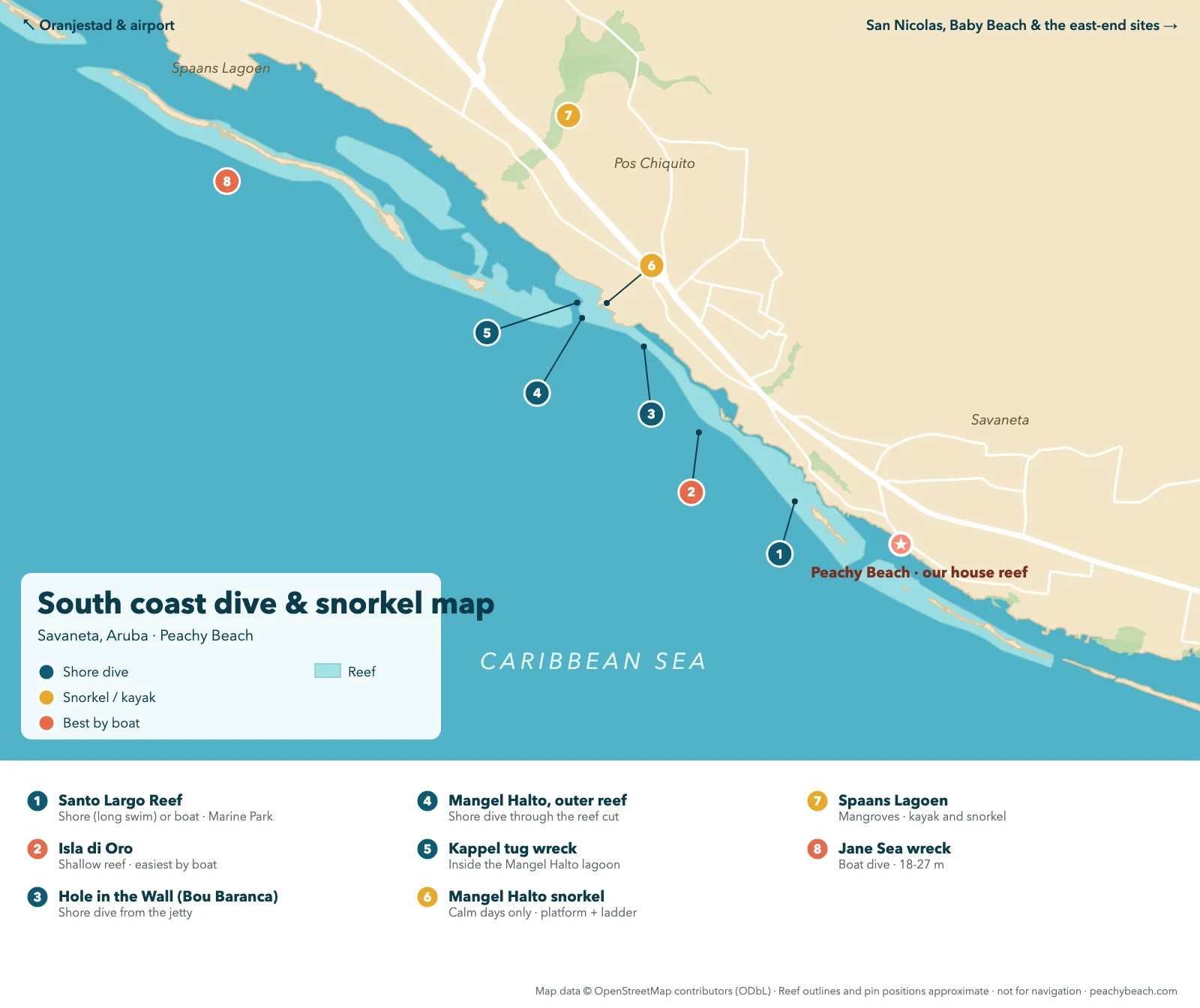
These are the sites we dive and snorkel most, from our own reef west to Spaans Lagoen, plus two bigger dives farther out. Depths are typical maximums. Conditions change with the wind, so treat the levels as a guide, not a promise.
| Site | How you get in | Depth | Best for | Why go |
|---|---|---|---|---|
| Our house reef, Savaneta | Walk in from the beach, swim across the bay | Shallow bay, then a drop-off from about 12 m (40 ft) | Experienced divers and strong swimmers; ask us about the crossing | Dive on your own schedule; turtles, nurse sharks, grouper |
| Santo Largo Reef | Long surface swim from a small beach, or boat | Down to about 37 m (120 ft) | Easy once you’re there | Big coral heads, morays, parrotfish, my giant-turtle dive |
| Isla di Oro | Boat (or a long wade through mangroves) | Under 10 m (30 ft) | Beginners | Brain, star and plate coral, lobster |
| Hole in the Wall (Bou Baranca) | Jetty or rocks, then a 100 m swim | About 25 m (80 ft) | Confident divers; there’s usually some current | Morays, trumpetfish, barracuda; drift to Mangel Halto |
| Mangel Halto, outer reef | Shore, out through the reef cut | 25 m (80 ft) and deeper | Confident divers | Reef slope with turtles, rays, octopus |
| Kappel tug wreck | Shore, inside the Mangel Halto lagoon | About 12–16 m (40–50 ft) | All certified divers | A small wreck sunk as an artificial reef in 2009 |
| Mangel Halto snorkel | Platform ladder or beach, 150–300 m to the reef | Up to 6 m (20 ft) | Strong snorkelers, calm days | Elkhorn coral, blue tang, French angelfish |
| Jane Sea wreck | Boat only | Deck 18 m, propeller 27 m (60–90 ft) | Experienced divers | A big upright freighter, barracuda, eagle rays |
| Baby Beach outer reef | Surf entry at the east end | About 16–18 m (55–60 ft) | Advanced only | Strong current; nurse sharks and turtles |
Is Aruba Good for Shore Diving?
Yes, and the south coast is where Aruba shore diving really shines. Dive guides often call Aruba a boat-diving island, and on the west coast that’s fair, because the famous wrecks like the Antilla sit offshore and you reach them by boat. Along the south coast, though, the reef runs close to land all the way from Spaans Lagoen to Savaneta, so you can walk in at several good spots.
The wind helps too. Aruba’s trade winds blow from the east in every month of the year, according to the island’s 30-year climate averages. On the north coast they pile waves onto the shore. On the south coast they mostly run along it, which keeps the water calmer. It’s not a swimming pool, as you’ll see below, but it’s the friendliest side of the island for getting in from the beach. It’s also the side where sargassum rarely shows up.
The water is warm all year, from about 79 °F (26 °C) in February to 85 °F (29 °C) in October. On a good day you can see 15 to 30 m (50 to 100 ft). Mangel Halto, Hole in the Wall, Isla di Oro and Santo Largo are all inside Aruba’s Marine Park, which is free to enter. Unlike Bonaire, Aruba doesn’t charge divers a nature fee or make you wear a dive tag.
Diving Our House Reef at Peachy Beach
Honestly, this is one of the greatest things of all time. At Peachy Beach you can kit up in your living room, walk out across the patio and step straight into the ocean, then swim out and hit the house reef. You dive completely on your own time, on your own schedule, doing your own thing. To me, it’s the most liberating way to dive there is.
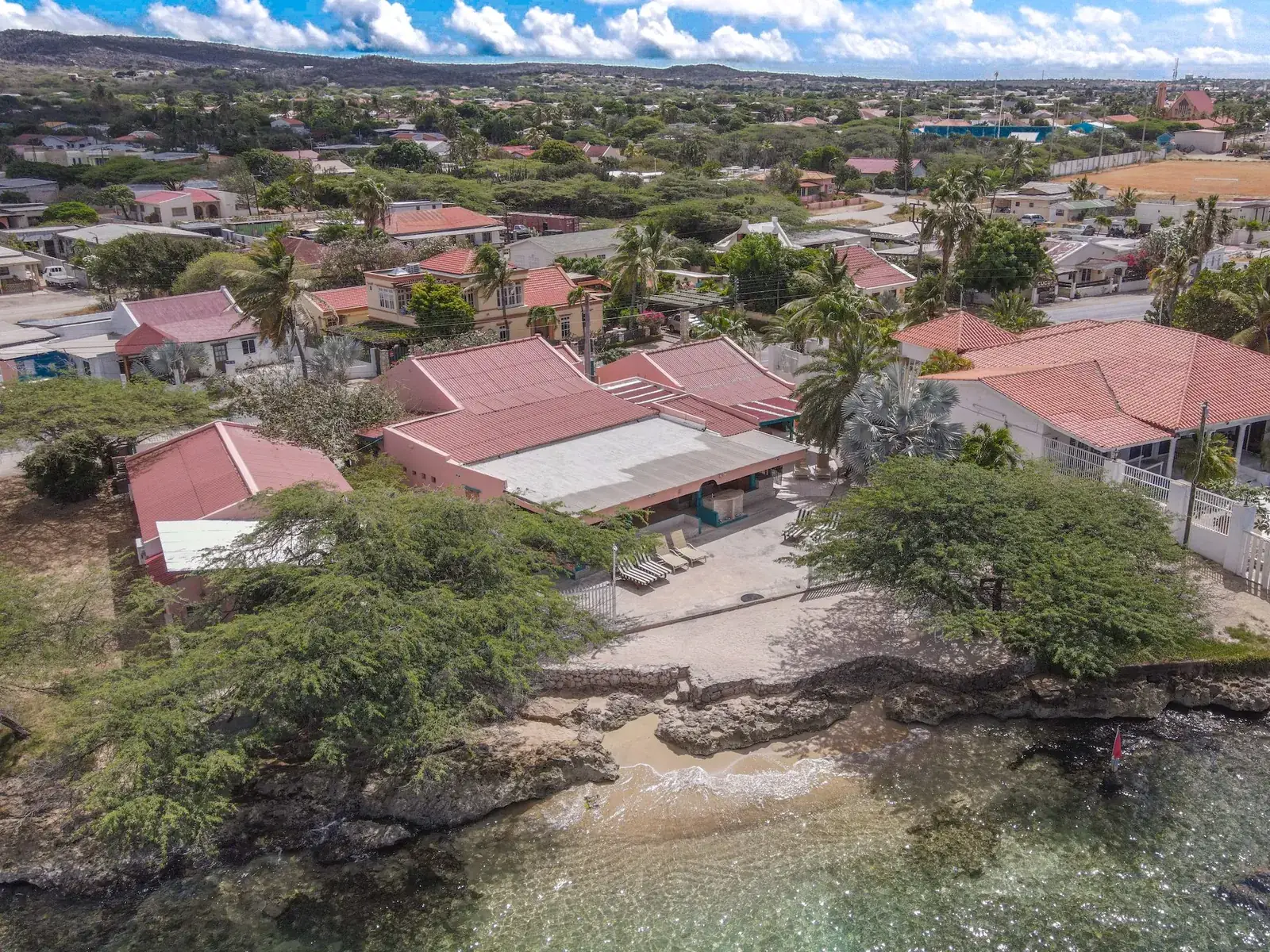
Here’s the honest picture. Right in front of the house there’s reef structure in the shallows. It isn’t that robust, since it’s mostly old, dead coral, but many of our guests tell us the snorkeling right out front is the best they’ve seen on the island. The real reef, with the soft corals and sea fans, is a swim across the bay, so you need to be a good swimmer. Out there the reef slopes away, and from around 12 m (40 ft) it drops into the blue. Over the years I’ve seen nurse sharks resting in a cave on our house reef, lobsters tucked under ledges, tons of sea turtles, beautiful grouper and all kinds of colorful fish.
Our stretch of coast sits right by the eastern edge of the Marine Park, and we treat it exactly the same way: look, don’t touch, take nothing home.
The house reef is best for experienced divers who are comfortable with a shore entry and a surface swim. If you’re newer to diving, or you’d just like company, our dive concierge can pair you with a local dive pro (more on that below). Snorkelers can explore the shallows right out front on calm days, and we provide masks, snorkels, fins and life jackets for free. Only strong swimmers should head across the bay.
How Do You Cross the Reef From Shore?
You cross where the reef gives you a gap, and you time it with the waves. Across the bay from our house there are several spots where you can cross. The trick is to find the right conditions and time your swim with the sets. The first time, I’d really recommend some local guidance, from us or from a dive shop.
- Look before you go. Watch the reef edge for a few minutes. If waves are breaking hard over it, choose another day or another site.
- Use the channels. Look for sandy gaps through the shallow reef, where there’s no coral to land on. At Mangel Halto it’s the light-blue channel out through the reef cut.
- Wait for a lull. Waves come in sets. Swim through in the quiet stretch after a set, and keep your fins up off the coral.
- Come back the way you went out. Remember your gap, or a landmark on shore lined up with it, so you aren’t hunting for a way through at the end of the dive.
- Pick your season. The wind is lightest in October and November and strongest around June, according to Aruba’s weather service. On the calmest days the crossing is easy.
Hole in the Wall (Bou Baranca), Pos Chiquito
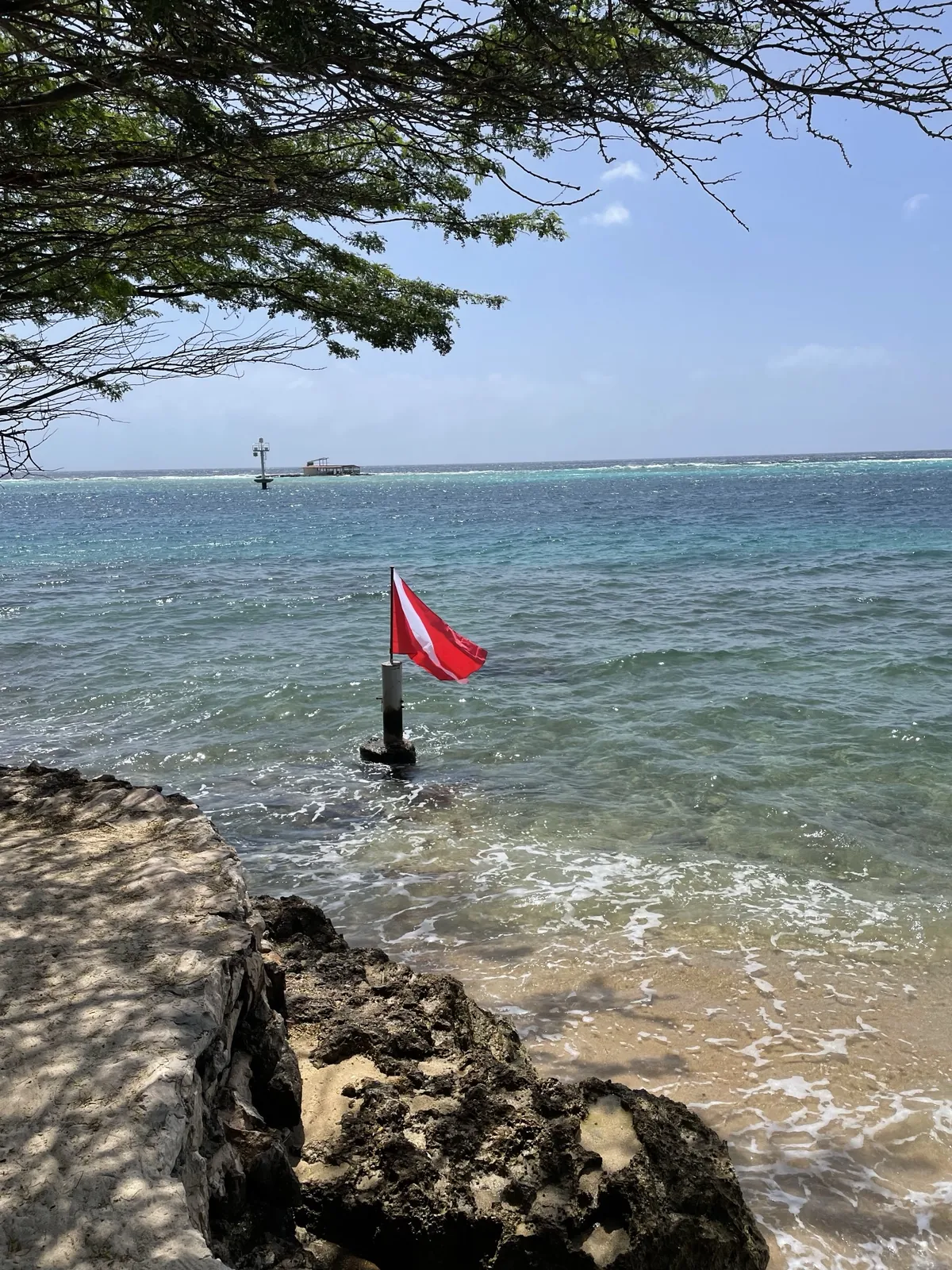
Hole in the Wall is the biggest shore dive on our side of the island. In Papiamento it’s called Bou Baranca (baranca means rock or cliff), and it’s named for an actual hole in the wall. Online guides also call it Rocky Beach or the Pos Chiquito dive.
Finding it: driving west from Savaneta toward Oranjestad, it’s just before you reach Mangel Halto Bar. Look for a small alleyway on the sea side of the road. It leads down to the water, with good parking on a little dirt lot. The entry is from a small jetty or the rocks beside it. The water there is too shallow for a giant stride, and the stones are slippery, so wade in carefully and swim out about 100 m (330 ft) before you descend.
The dive: the reef slopes down to about 25 m (80 ft), with green and spotted moray eels, trumpetfish, schools of blue tang and the odd barracuda. There’s almost always some current here, usually running west, plus waves at the entry when it’s windy, so plan to swim into the current first. A popular option is to drift west along the reef and come out at Mangel Halto, if someone can move the car. Online guides disagree about how hard this dive is. The honest answer is that it depends on the day, and on a first visit it’s worth going with a guide. Boats cross over the outer reef, so carry a surface marker buoy.
The car key: every shore diver here faces the same question. Bring a waterproof key pouch or clip the key inside your BCD, and leave nothing in the car. Government travel advice says the same about any beach parking in Aruba.
After the dive: Tia Rosa’s bright yellow stand in Pos Chiquito is just up the road for an arepa or a pastechi. It’s one of the spots in our Savaneta dining guide.
Mangel Halto: Diving the Reef and Snorkeling the Lagoon
Mangel Halto is the south coast’s most famous water spot. It’s a mangrove-lined lagoon behind the reef, with a small wreck inside and a big reef slope outside. It’s a few minutes’ drive from us, right next to La Tavola, one of our favorite Savaneta Aruba restaurants.
- Inside the lagoon: the Kappel, a small tugboat that JADS Dive Center sank as an artificial reef in 2009, sits in about 12–16 m (40–50 ft), with morays and schooling fish around it. Enter from the beach or the concrete steps, not off the swimming platform, and watch for boats in the lagoon.
- The outer reef: follow the shallow light-blue channel out through the reef cut, and the reef slopes to 25 m (80 ft) and beyond. Look for turtles, rays, octopus and green morays. When the wind is up, the current outside can be strong and waves break at the cut.
- Snorkeling: from the wooden platform it’s about 300 m (330 yards) to the reef, or about 200 m (220 yards) through the cut in the mangroves. The reef top is shallow, down to about 6 m (20 ft), with elkhorn coral, blue tang and French angelfish. Go on calm days only. Boats use the buoyed channel at the western cut, so stay out of it. There’s no lifeguard.
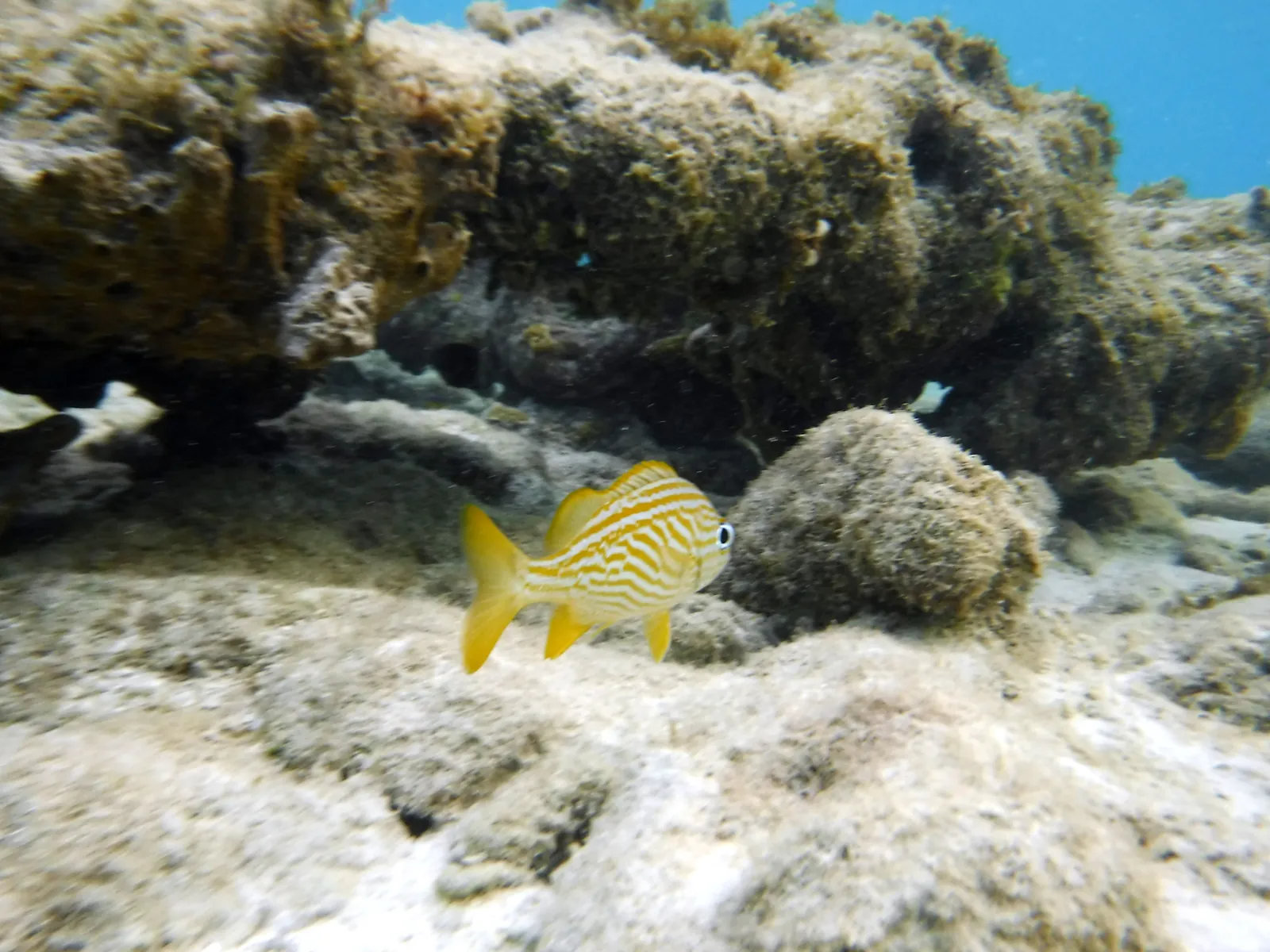
Kayak and snorkel tours start arriving around 8:30 in the morning, so get there early if you want it to yourself. Our guide to Savaneta covers the beach itself.
Santo Largo: Where I Saw the Biggest Turtles of My Life
Santo Largo is beautiful. I once dived there and saw several sea turtles, each one bigger than me, the biggest I’ve ever seen, all hanging out together on one dive. It was incredible.
The reef sits just west of Savaneta, off the old Commandeurs Baai, inside the Marine Park. It’s an easy dive with little current, big coral formations, morays and parrotfish, and visibility often 20–30 m (65–100 ft). It also goes deep: the Dutch dive guide duikersgids lists it as one of Aruba’s deeper sites, down to about 37 m (120 ft). There’s a small beach, but it’s a long surface swim out to the reef, so many divers go by boat. Nautilus Dive Center runs guided shore dives here.
Isla di Oro, next door
Isla di Oro, between Santo Largo and Pos Chiquito, is a shallow, easy reef (under 10 m, or 30 ft) on a wide sand strip, with brain, star and plate coral, lobster and snapper. It was once a party island. Getting there from shore means a long walk and wade through the mangroves, so it’s really a boat or kayak trip.
Night Diving and the Glowing “String of Pearls”
Yes, you can night dive in Aruba, and on the south coast it’s easy to arrange. Nautilus runs night shore dives at Mangel Halto and Hole in the Wall, and Aruba Bob runs night dives and a sunset-into-night snorkel.
There’s one night dive I love telling people about. At a certain time of the month, tiny glowing shrimp put on a light show. They’re ostracods (that’s the English name, from the Greek word for shell), tiny “seed shrimp” smaller than a tomato seed. The males flash little trails of blue light to attract females, rising off the reef like strings of pearls. The display happens only in the Caribbean, starting a few nights after the full moon, about 45 minutes to an hour after sunset, and it lasts 20 to 30 minutes. Turn your light off and the water fills with glowing dots.
Bonaire, our neighbor, is famous for these “string of pearls” dives. In Aruba, as far as we can find, no shop runs a dedicated one. If you book a night dive, aim for a few nights after the full moon, and ask your guide to switch off the lights for a few minutes.
What Sea Life Will You See on Aruba’s South Coast?
Turtles, morays and clouds of reef fish on almost any dive, with nurse sharks, rays and big grouper if you’re lucky. Many of them are legally protected in Aruba, so here’s what to look for and how to behave around it.
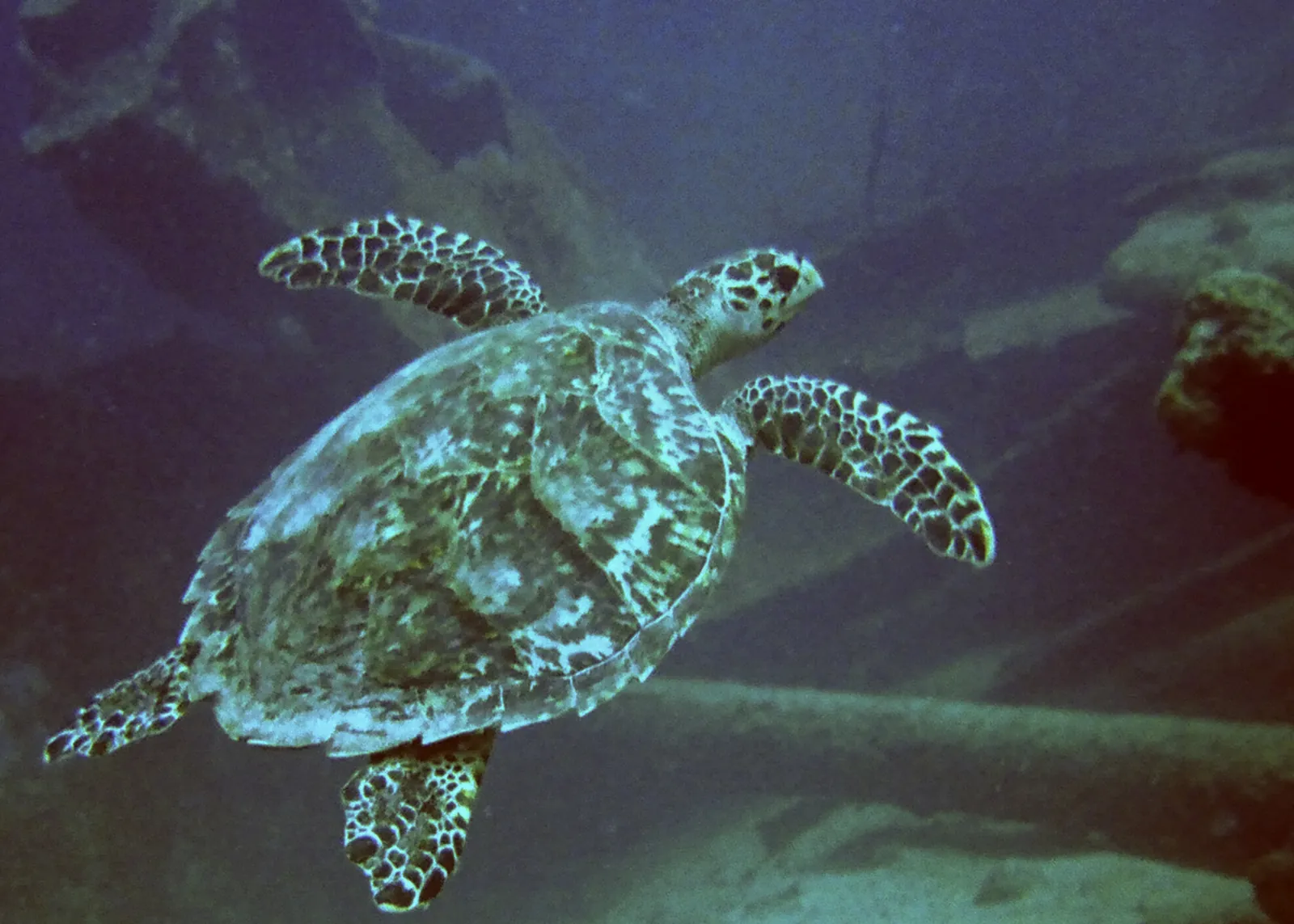
- Sea turtles: young green turtles live here year-round and graze on seagrass and algae. Hawksbills and loggerheads visit the reefs too. All sea turtles have been protected in Aruba since 1987. Stay about 2 m (6 ft) away, and never touch, chase or ride one. If you find a hurt or nesting turtle, call Turtugaruba on +297 592 9393.
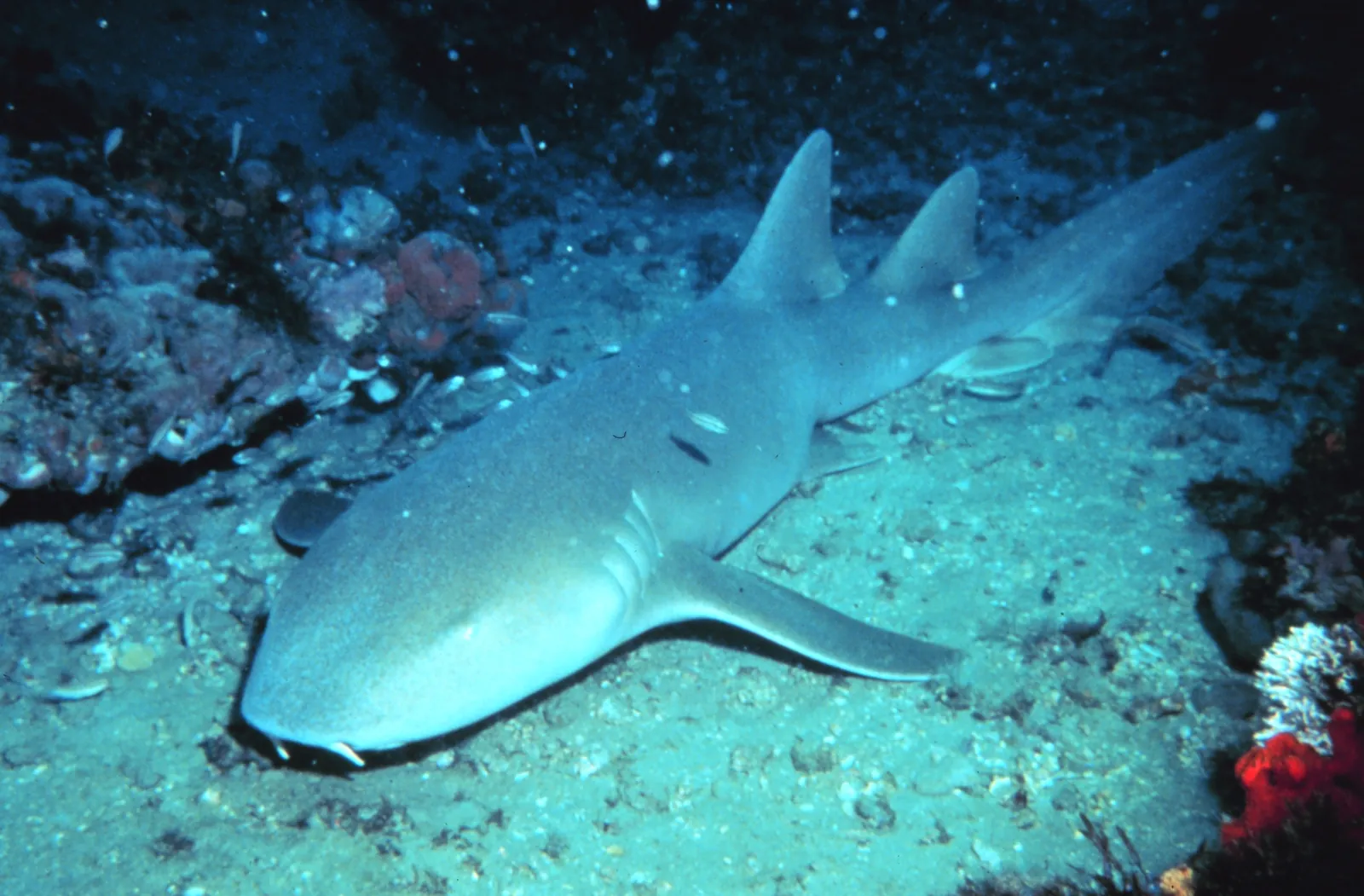
- Nurse sharks: they spend the day resting in caves and under ledges, and hunt at night. They’re harmless if you leave them alone. The rare bites usually happen when someone grabs or corners one.
- Lobster: Caribbean spiny lobster is a protected species in Aruba, so look and don’t take.
- Grouper: I’ve seen some beautiful grouper on these reefs. Nassau and goliath grouper are both protected.
- Reef regulars: green and spotted morays, parrotfish (all protected, because they keep the reef clean), blue tang, French angelfish, grunts and snapper. Out deeper: barracuda, jacks and eagle rays.
- Coral: the shallow elkhorn coral on the south coast is critically endangered, and all coral in Aruba is protected.
Lionfish: The One Fish We Want Off the Reef
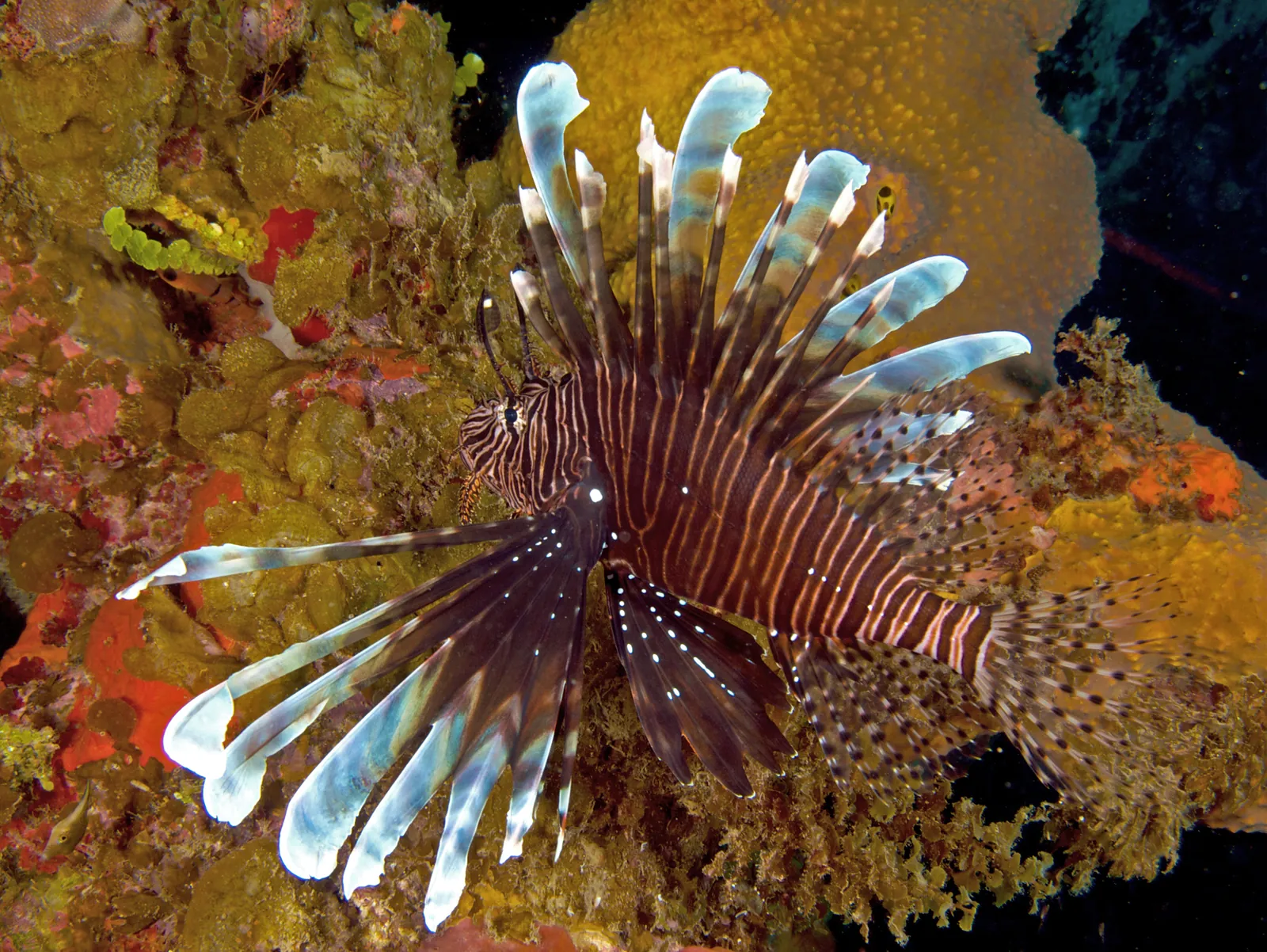
Lionfish don’t belong here. They’re from the Indo-Pacific, they have no natural predators in the Caribbean, and they eat huge numbers of young reef fish. The first one in Aruba was spotted off Oranjestad in 2009, and now they’re found on reefs all around the island. One study in the Bahamas found that a single lionfish on a small reef cut the number of young fish settling there by 79% in five weeks. Aruba’s Marine Park managers want divers to keep removing them. On every dive, lionfish are the one fish I’m happy to see gone.
Here’s the part visitors get wrong: spearguns and spearfishing are illegal in Aruba. Since 2020, the government has tolerated pole spears for culling lionfish, but only for registered residents with a permit, in daylight, and not inside the Marine Park. The Coast Guard also says you can’t swim out from shore with a harpoon. So don’t pack a spear. If you want to help, book a lionfish dive or course with a local shop. Aruba Bob lists a lionfish option from the Aruba Lionfish Initiative (ALFI), and Pure Diving in Oranjestad teaches ALFI’s hunter course.
Handle them carefully. A lionfish has 18 venomous spines. If you get stung, soak the wound in water as hot as you can stand, but no hotter than 113 °F (45 °C), for 30 to 90 minutes. Have someone else test the temperature first, and then get it checked by a doctor.
The best part is that lionfish is delicious. The venom is only in the spines, and the meat is mild and white. Coming back from a dive and whipping up a quick lionfish ceviche on the patio is about as good as island life gets. Dice the fillets and cover them in fresh lime juice until they turn opaque, then add red onion, cilantro, a little hot pepper and salt. Keep the fish cold the whole time. Lime juice doesn’t kill parasites the way freezing does, according to the FDA, so freezing the fillets first is the safer route, and anyone pregnant, very young or with a weak immune system should skip raw fish altogether.
Snorkeling, Kayaking and Paddleboarding From the Villa
You don’t need a tank to enjoy this coast. Every villa comes with complimentary kayaks, life jackets, masks, snorkels and fins, plus beach chairs and coolers, and we have shared paddleboards on the property. You can spend the day on the beach, paddle along the shore, snorkel the shallows and just enjoy the sea life.
- Snorkel right out front on a calm day. It’s shallow, so keep your fins up and stay off the coral, and wear a life jacket if you’re not a strong swimmer. The healthier reef across the bay is for good swimmers.
- Paddle along the coast by kayak or paddleboard, inside the reef where the water is calmest.
- Visit Sea Glass Island, a little sandbar off Savaneta covered in surf-tumbled sea glass. You can only get there by kayak or boat. Vale’s Rambo Adventures runs guided kayak trips from the boat ramp next to the Flying Fishbone.
- Get out on a boat. Through our additional services we can arrange boat tours, from a yacht to a catamaran.
We’re happy to guide our guests, so ask us for recommendations any time. For more on life at the property, see our guide to Savaneta beachfront rentals at Peachy Beach.
South Coast Dive Shops and Guides
There are two dive shops right here in Savaneta, and both run guided shore dives at the sites above. Nobody paid to be listed. Prices are as the shops listed them in October 2026, so check before you book.
- Aruba Bob Snorkel & Scuba (Savaneta 305). Guided shore dives (about $100), Discover Scuba for non-certified beginners (about $120), two-tank boat dives (about $190), night dives, and courses from Open Water up to Divemaster. It also runs Mangel Halto snorkel tours with sea scooters and lists a lionfish (ALFI) option.
- Nautilus Dive Center (Ir. Luymesstraat 3, Savaneta, a few minutes’ walk from Mangel Halto). Guided shore dives at Mangel Halto, Hole in the Wall and Santo Largo: about $105 for one tank or $160 for two, with no more than six divers and free pickup. You need Open Water certification plus four logged dives. It also has night shore dives, Nitrox and rental gear.
- JADS Dive Center (Seroe Colorado, by Baby Beach). A two-tank “Southern Coast” shore trip (about $105), plus tank rental for certified divers who want to go on their own (about $16 a tank per day, with weights extra). That makes it the easy option if you want to dive our house reef without a guide.
Come Dive With Us: Our Dive Concierge
We think of Peachy Beach as an informal dive resort, a little paradise for divers where you can gear up on the patio and walk straight into the sea. We partner with the best local dive pros on the south coast to coordinate dives for our guests, as a concierge service. Tell us what you have in mind and we’ll set it up with the right people: a guided dive on the house reef, a drift at Hole in the Wall, a boat trip, a refresher, or your very first Discover Scuba. Just ask when you book, or any time during your stay.
Reef Rules and Etiquette: How to Help Save the Reef
Aruba’s reefs are under real pressure. Stony coral tissue loss disease reached Aruba in late 2022, and lionfish are here to stay. The rules are simple, and most of them are about keeping your hands to yourself.
- The Marine Park is free and open at all hours. It’s run by the Aruba Conservation Foundation (ACF), and feeding wildlife is prohibited.
- Look, don’t touch. Don’t stand on coral or seagrass, and don’t feed the fish.
- Take nothing. Taking shells, coral or sand off the island is illegal, and you can be fined at the airport.
- Mind your sunscreen. Sunscreen with oxybenzone has been banned in Aruba since July 2020. A mineral sunscreen or a rash guard is kinder to the reef anyway.
- No spearfishing, and no taking lobster, turtles or parrotfish. See the lionfish section for the one exception, which visitors can’t use on their own.
- Join a cleanup. The Aruba Reef Care Project has run a volunteer beach and reef cleanup every year for more than 25 years. Local groups have also planted coral nurseries along this coast, including one off Savaneta in 2019.
Aruba Shore Diving Safety: What to Know Before You Go In
The south coast is calm by Aruba standards, but it’s still the open sea. These are the habits that keep shore dives here easy:
- Dive with a buddy and agree on your plan, turn-around time and exit before you get in.
- Carry a surface marker buoy. Fast boats cross the outer reef and run through the channels at Mangel Halto. Stay out of buoyed channels, and send the buoy up for your safety stop.
- Know the current. The drift along the south coast usually sets west. Swim into it first so it brings you home, or plan a one-way drift with a car at the other end.
- Respect the waves at the reef edge. If they’re breaking hard where you need to cross, dive somewhere else that day.
- Know who to call. The emergency number is 911, and the Coast Guard is 913. For years, Aruba divers with decompression sickness had to be flown to Curaçao. In 2026, Horacio Oduber Hospital in Oranjestad installed its own hyperbaric chamber. Dive-accident insurance, such as DAN’s, is still worth having.
- Don’t fly too soon. DAN’s flying-after-diving guidelines say to wait at least 12 hours after a single no-stop dive, and 18 hours after several dives a day or several days of diving.
- Leave nothing in the car. Rental cars at beach parking spots are an easy target.
When Is the Best Time for Shore Diving in Aruba?
Any time of year. Aruba sits outside the hurricane belt, and the water stays between about 79 °F (26 °C) in February and 85 °F (29 °C) in October. For reef crossings, I like the fall: October and November have the lightest winds of the year. The rainy season runs from October to December, but Aruba only gets about 450 mm (18 inches) of rain in a whole year. June has the strongest trade winds, so expect a bit more chop at the entries. On a day the wind is howling, take a break from the water. Explore Arikok National Park, or work through our list of the best things to do in Aruba.
Aruba Shore Diving FAQ
Is Aruba good for scuba diving?
Yes. Aruba has warm, clear water all year, famous wrecks like the Antilla, and a healthy south-coast reef you can reach from shore. Most visitors dive from boats on the west coast, while the south coast around Savaneta and Mangel Halto is the best area for shore diving.
Does Aruba have shore diving?
Yes, mostly on the south coast. The best-known shore dives are Mangel Halto (the outer reef and the Kappel tug wreck), Hole in the Wall in Pos Chiquito, Santo Largo and, for advanced divers, Baby Beach’s outer reef. From some beachfront homes in Savaneta, like ours, you can also walk in and swim out to the reef.
Do you need to be certified to shore dive in Aruba?
To dive without an instructor, yes. Dive shops ask for a certification card for guided dives, and Nautilus also asks for at least four logged dives after Open Water. If you’re not certified, a Discover Scuba session (about $120) gets you underwater with an instructor.
How much does scuba diving in Aruba cost?
On the south coast in October 2026, a guided one-tank shore dive cost about $100–105, a two-tank shore dive $105–160, and a two-tank boat dive about $190. Certified divers can rent a tank at JADS for about $16 a day.
Is Mangel Halto safe?
On a calm day, for confident swimmers, yes. The risks are current near the reef cut and on the outer reef, boats in the channels, and the long swim back. There’s no lifeguard. Go with a buddy, wear fins, stay out of the buoyed channel, and skip it when the wind is up.
Can you swim with sea turtles in Aruba?
Yes. Young green turtles live along the coast year-round, and hawksbills and loggerheads visit the reefs too. Watch them from about 2 m (6 ft) away and never touch or chase them. They’re protected by law.
Can visitors spearfish or hunt lionfish in Aruba?
No spearfishing for visitors. Spearguns are illegal, and pole-spearing lionfish is only tolerated for registered residents with a permit. To help with lionfish, book a guided lionfish dive or course through a local dive shop.
Is diving better in Aruba or Bonaire?
Bonaire is the Caribbean’s shore-diving capital, with dozens of marked shore-dive sites. Aruba has fewer shore dives, but the south coast has some very good ones, plus bigger wrecks off the west coast and a lot more to do once you’re out of the water.
Come Dive Our Reef
If walking out of your bedroom and into the sea with your dive gear on sounds like your kind of vacation, come stay with us. Our villas sit right on the water in Savaneta, and every one comes with free snorkel gear and kayaks. Divers love the Beachfront Suite & Spacious Patio, whose big covered patio faces the ocean, so it’s a natural place to set up your gear, and our dive concierge can line up guided dives for you. Families who want to snorkel together can take the Beachfront Two-Bedroom Villa. And after the dive, fried fish on the dock at Zeerovers is a short walk away.
Ready to dive the south coast? See our beachfront villas and check availability.
About the author: Dan has been part of the Savaneta community for more than 20 years and runs Peachy Beach, a handful of beachfront villas on the Savaneta waterfront. He dives and snorkels these reefs, starting with our own house reef across the bay. The site details are checked against Aruba’s Marine Park law, the Aruba Conservation Foundation, dive-site guides and the shops themselves. Nobody paid to be included. We do rent villas on this coast, so we’ve tried to be straight about the conditions, the currents and the rules.
Dive these sites and spot something that’s changed? Tell us and we’ll update this page.
Top photo: heading out for a shore dive from Peachy Beach. Other photo credits are in the captions.